
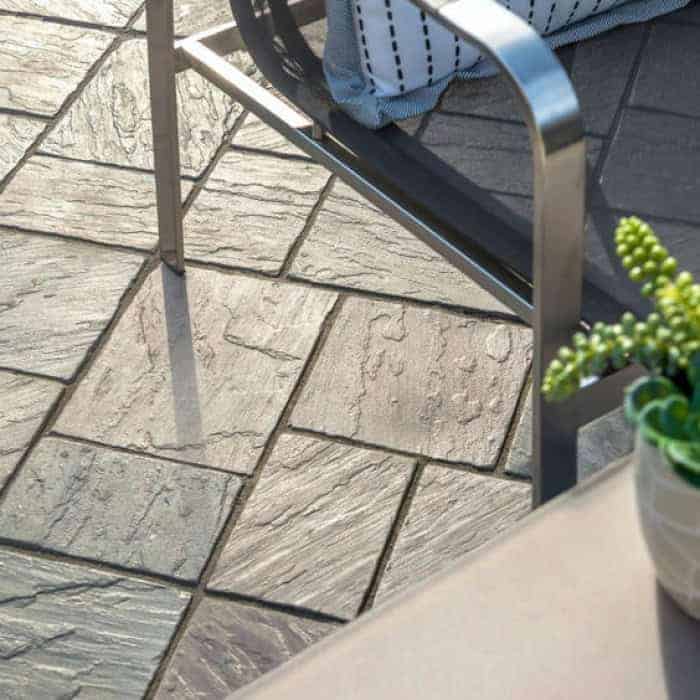
Inspired by the texture of natural cut flagstone, Richcliff offers superior durability and timeless appeal for patios, walkways, and even driveways when utilizing the Random Bundle. A multitude of stone textures were cast using Reala™ Technology, which ensures that finished projects will have a completely random, and natural appearance. And unlike natural stone, which can crack, split and fade, Richcliff is virtually indestructible. Ultima™ Concrete Technology makes Richcliff up to four times stronger than conventional poured concrete. A new large rectangle size is now available for use on its own or in combination with the traditional 3-stone random bundle for expanded patterning options and a larger scale look.
The modular cut flagstone appearance of Richcliff is used by designers for both traditional and contemporary designs. EnduraColor™, Reala™ Technology, and Ultima™ Concrete Technology are the features that make Richcliff ideal for driveways, patios and pool decks. Consider accenting with Courtstone® and Copthorne® for a striking design.
RECOMMENDED BASE STABILIZATION – one layer of DriveGrid™” stabilization grid between subgrade and base material. Recommended depth 8” to 10” below pavers for maximum stability and performance. Use under Standard Base or Permeable Base.
STANDARD BASE – Min. 6” – 8” of ¾” Crusher Run gravel (any road base standard in accordance with ASTM-D2940) compacted to 98% Standard Proctor Density (SPD).
STANDARD BEDDING COURSE – 1” thick of coarse sand– in accordance with ASTM-D2940 screeded over base.
ALTERNATIVE PERMEABLE BASE – Min. 6” – 8” of ¾“ clear open-graded stone compacted to achieve full particle lock-up and consolidation. (Clear open-graded does not compact but does consolidate slightly by rattling the particles together.)
ALTERNATIVE PERMEABLE BEDDING COURSE –1” thick of 1/4” clear open-graded chip stone – (ASTM No. 8) screeded over base.
SPECIAL NOTE: CONCRETE DIRECT OVERLAY –In some areas of the country and in some applications pavers are very successfully placed directly over concrete. Concrete as a base is in itself quite strong, but it can affect the structural integrity of the paver particularly in vehicular applications, where the concrete below is sub-par. The following considerations must be taken into account to insure that the concrete below the surface is ideal:
JOINTING MATERIAL AND JOINT STABILIZATION
All sands must meet ASTM C144 or C33 Specifications. For best appearance and optimal performance,, keep jointing materials approximately 1/8” below the chamfer (bevel edge) of the paver.
Good Option: Ordinary sharp jointing sand in accordance with ASTM C144 or C33. (Common name: Concrete Sand)
Best Option: Any polymeric sand or ordinary concrete sand stabilized by a water-based or solvent-based joint sand stabilizer sealer. Always follow manufacturer’s application specifications and requirements.
HANDLING – Do not bang edges together as chipping may occur. Because if its size and weight, always use a vacuum lifter device to place Richcliff XL units.
EDGE RESTRAINT – Always install an edge restraint around the perimeter of any paver installation not restrained by building structures. Spike-in edge restraints come in plastic and metal and work well for most applications. A concrete curb or a sub-surface concrete wedge can also be installed to retain the edge.
PAVER COMPACTION – Always use a protective polymer pad on the bottom of your compactor when doing the final compaction of the pavers. An alternative is to use a rubber-roller compactor for the final compaction.
CLEANERS – Any cleaner specifically designed for pavers may be used for color restoration or general cleaning. Follow manufacturer’s dilution rates and application procedures. Always test a small area to make sure the results are as expected.
SEALERS
| Color | Dawn Mist, Pebble Taupe, Smoke Shale |
|---|